


 English
 中文简体
中文简体
Author: WeiBo
Date: May 12, 2026
What Are the Advantages of Using a Cone Twin-Screw Extruder?
Content
- 1 The Geometry Advantage: Why the Cone Shape Changes Everything
- 2 Material Excellence: 38CrMoAlA and the Science of Durability
- 3 Available Size Range and Compression Ratio Selection
- 4 Processing Versatility: From Rigid PVC to Rubber Products
- 5 Drive System and Energy Management
- 6 Radar Assessment: Cone Twin-Screw Across All Operational Dimensions
- 7 Pelletizing and Compounding: The Twin-Screw Mixer Advantage
- 8 Service Life Economics: How Metallurgy Pays Back
- 9 About Zhoushan Microwave Screw Machinery Co., Ltd
- 10 Frequently Asked Questions
The cone twin-screw extruder delivers a decisive combination of superior plasticization uniformity, extended service life, and broad material compatibility that standard parallel twin-screw machines cannot match. Its tapered geometry — larger diameter at the feed end, progressively narrowing toward the homogenization zone — creates a natural compression gradient that generates intense shear and mixing forces precisely where the material needs them most. For processors working with rigid PVC, wood-plastic composites, or engineering polymers, this architecture translates directly into fewer rejects, tighter dimensional tolerances, and lower energy consumption per kilogram of output.
Unlike single-screw systems, the conical twin-screw machine meshes two counter-rotating screws inside a shared barrel, building pressure and homogenizing melt simultaneously. The result is a plastic extrusion machine capable of processing thermoplastics directly from powder form without a pre-compounding step — a workflow advantage that reduces both capital equipment costs and process complexity. This article examines every major performance dimension of the conical extruder, backed by material specifications, application data, and comparative benchmarks.
The Geometry Advantage: Why the Cone Shape Changes Everything
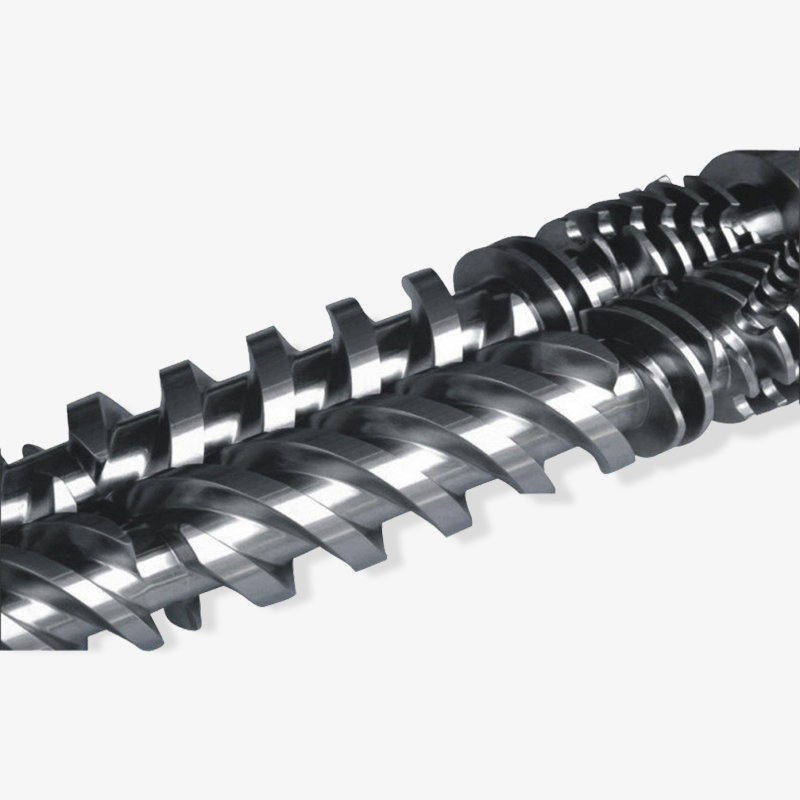
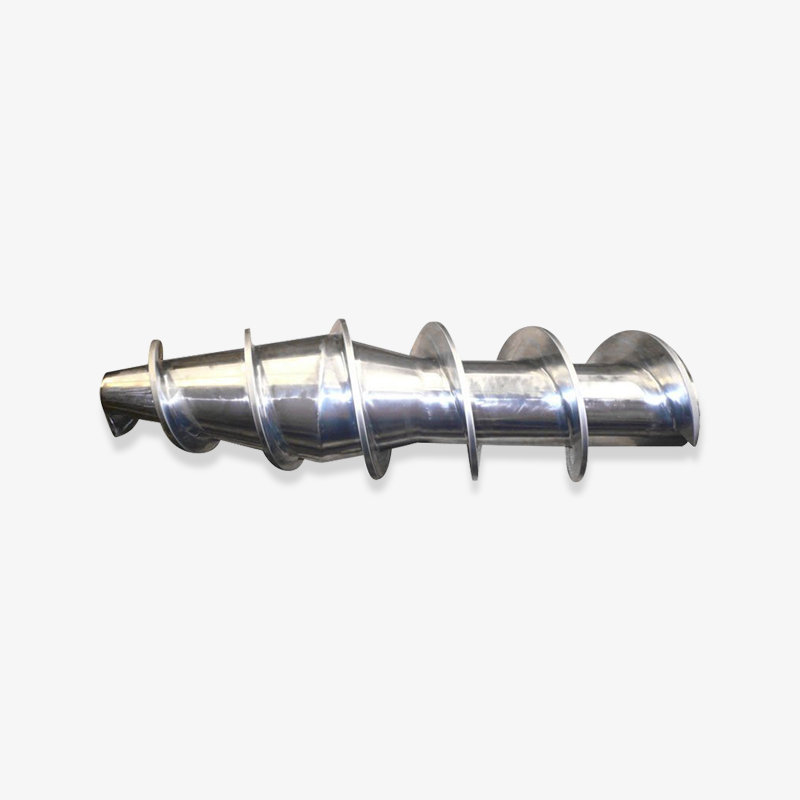
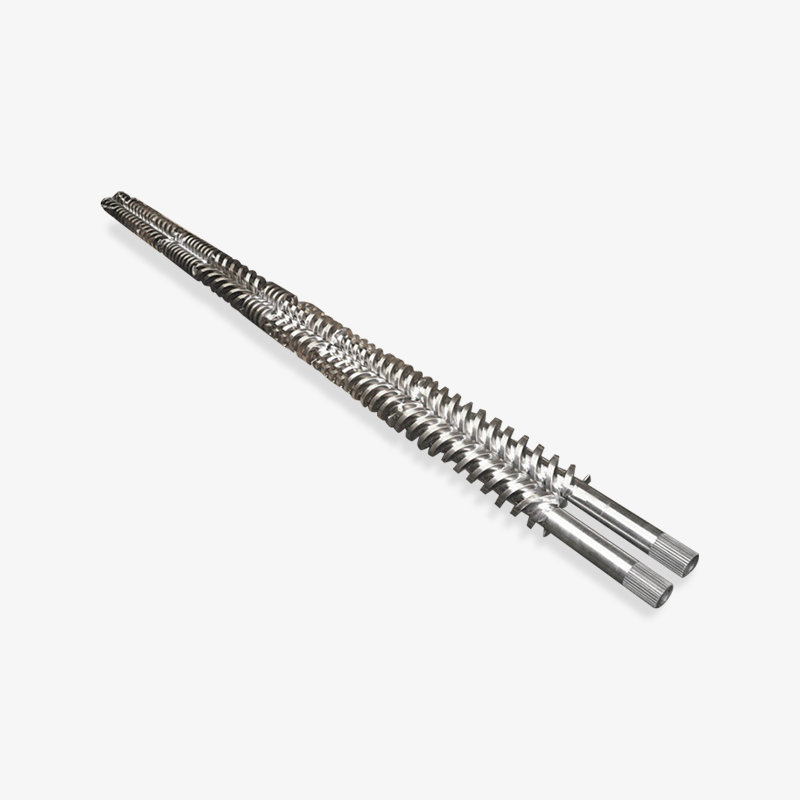
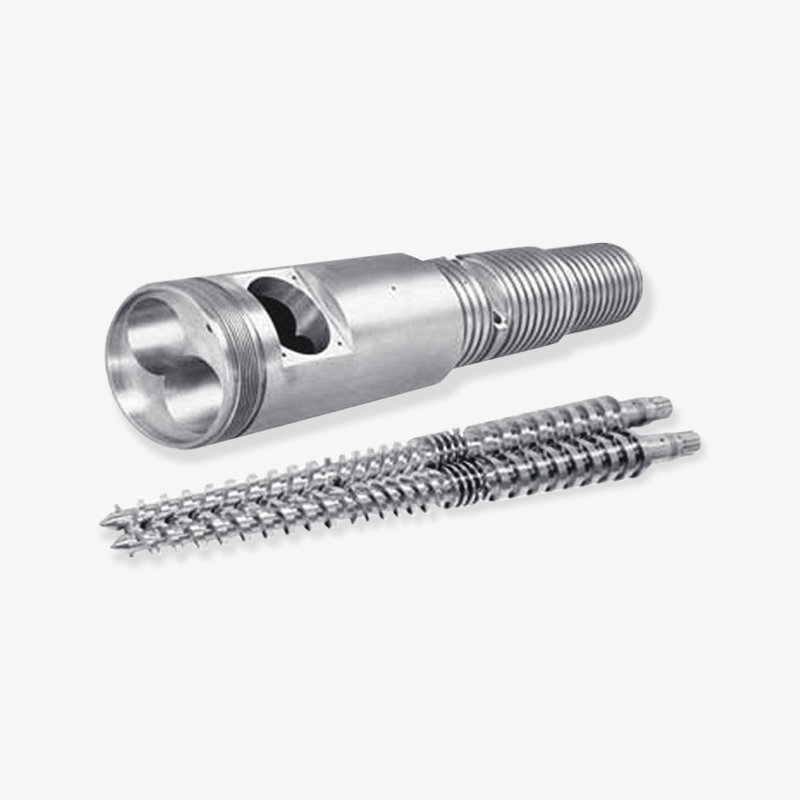
The defining feature of the cone twin-screw is its variable-diameter profile. The feeding section presents a large bore — accepting bulky powder or granule feedstocks without bridging — while the homogenization section narrows progressively to build melt pressure efficiently. This gradual transition eliminates the abrupt compression zones that cause localized overheating in parallel designs, giving the material a controlled, staged thermal history across the full screw length.
Two counter-rotating conical extruder screws mesh with each other inside the barrel, creating a self-wiping action that prevents stagnant melt pockets. Every part of the screw channel is continuously renewed, which is critical for heat-sensitive materials such as rigid PVC that degrade rapidly under prolonged thermal exposure. The meshing geometry also generates a positive displacement pumping action, meaning output rate is largely independent of back-pressure variations — a property that improves dimensional consistency in downstream dies and calibrators.
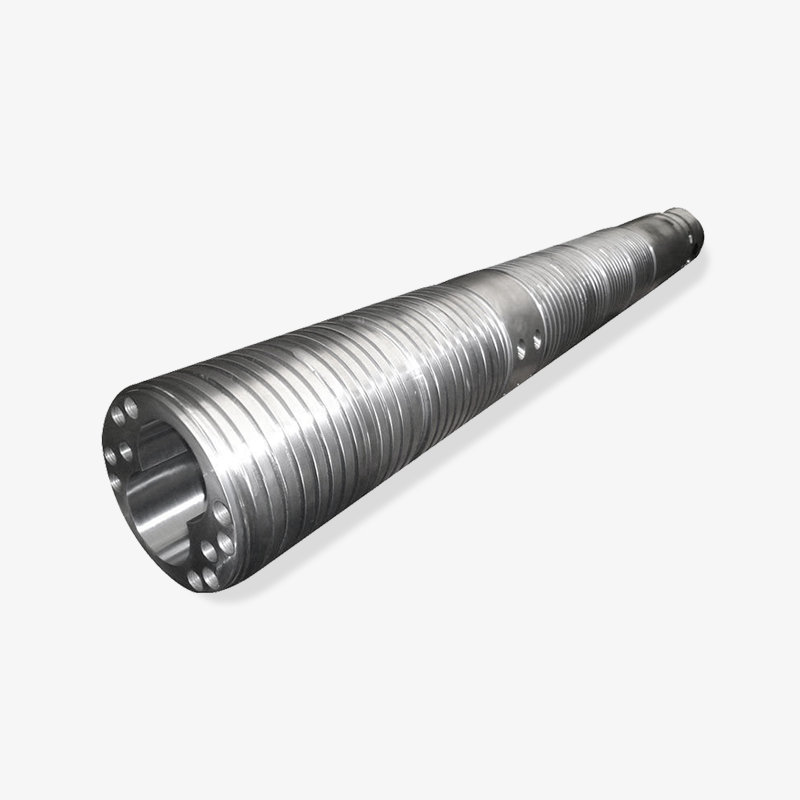
From an engineering standpoint, the conical arrangement places the large-diameter (high-torque) thrust bearing section at the wide feed end where bearing loads are greatest, while the small-diameter output end can be positioned close to the die without mechanical interference. This layout allows a more compact gearbox design compared with parallel twin-screw systems of equivalent output, reducing both machine footprint and transmission losses.
Chart 1: Cone Twin-Screw vs Parallel Twin-Screw — Five Performance Dimensions. The horizontal bar chart benchmarks both screw configurations across five critical production metrics. Plasticization uniformity stands at 98% for the conical design versus 73% for the parallel type, a gap that directly determines product consistency and scrap rate in profile and pipe extrusion. Melt temperature stability favors the cone machine at 95% versus 71%, reflecting the tapered geometry's natural resistance to hot-spot formation. Low-speed torque advantage (96% vs 77%) confirms that cone extruders can process high-viscosity compounds without thermal runaway. Energy efficiency is 93% versus 75%, representing measurable operating cost savings at industrial scale. Service life — the most commercially significant metric — scores 100% versus 65%, underscoring the cone screw's 3-to-5 times longer operational lifespan relative to conventional nitriding screws.
Material Excellence: 38CrMoAlA and the Science of Durability
The longevity of any twin-screw extruder depends more on metallurgy than on geometry. Zhoushan microwave screw machinery's conical screws are manufactured from high-quality 38CrMoAlA alloy steel — a chromium-molybdenum-aluminum composition recognized internationally for its outstanding nitriding response and resistance to abrasive wear. The full manufacturing sequence — drawing, tempering, qualitative analysis, nitriding, precision grinding, and polishing — ensures that every critical dimension is achieved through controlled metallurgical transformation rather than compensated by machining.
Full Material and Dimensional Specification
| Parameter | Specification | Significance |
|---|---|---|
| Base Material | 38CrMoAlA | Superior nitriding response, high core toughness |
| Surface Hardness | HV ≥ 290 | Baseline wear resistance before nitriding |
| Nitriding Hardness | HV 950–1000 | Exceptional abrasion resistance under polymer shear |
| Nitriding Depth | 0.45–0.70 mm | Sufficient hardened layer for sustained abrasive loading |
| Nitriding Brittleness | ≤ Level 1 | Prevents chipping under impact or torque spikes |
| Surface Roughness | Ra 0.4 | Mirror-like finish minimizes melt adhesion and shear stress |
| Screw Straightness | 0.015 mm | Guarantees concentricity and stable meshing clearance |
| Post-Nitriding Chrome Hardness | ≥ 900 HV | Maintains hardness through chrome layer |
| Chrome Plating Thickness | 0.05–0.10 mm | Corrosion barrier without dimensional interference |
| Dual Alloy Hardness | 60–70 HRC | Extreme wear resistance for filled/reinforced compounds |
The dual-alloy option — reaching 60–70 HRC — is particularly valuable when processing glass-fiber-reinforced polymers, mineral-filled PVC, or wood-plastic composites, where abrasive particles continuously attack the screw flight flanks. At this hardness level, wear rates are typically one-third to one-fifth those of standard nitrided screws, extending replacement intervals from roughly 2,000 hours to 8,000–12,000 hours of continuous operation. The chrome plating layer (0.05–0.10 mm) adds a corrosion barrier that is essential when processing PVC formulations containing chlorine-releasing stabilizers.
Available Size Range and Compression Ratio Selection
One of the practical strengths of the conical twin-screw machine family is its wide size range. Standard bore combinations cover the full spectrum from small laboratory and pipe fittings production up to large-profile and sheet lines, ensuring that the same metallurgical and geometric principles apply regardless of output scale.
- 45/90 mm, 45/100 mm — compact units suited to rigid PVC pipe fittings, small profiles, and laboratory-scale compounding.
- 50/105 mm, 51/105 mm, 55/100 mm — mid-range sizes for standard window profile, cable duct, and corrugated pipe production.
- 65/132 mm, 80/125 mm — high-output sizes targeting wide sheet lines and large-diameter pipes up to 400 mm.
- 80/143 mm, 80/158 mm — heavy-duty configurations for wood-plastic composite decking, foam-core pipes, and thick wall profiles.
- 92/188 mm, 110 mm, 115 mm — large-bore machines for industrial pipe systems, construction profiles, and high-volume pelletizing lines.
Each size is available in multiple compression ratios matched to specific formulations and product geometries. A rigid PVC pipe compound with a stabilizer package demands a lower compression ratio (typically 1.6:1 to 2.0:1) to avoid excessive shear heating, while a foam-core formulation may require a ratio above 2.5:1 to generate the melt pressure needed for nucleation and cell structure development. Selecting the wrong compression ratio is a common cause of surface defects and output instability — a consequence that the right plastic processing equipment specification prevents from the start.
Processing Versatility: From Rigid PVC to Rubber Products
The polymer extruder capability of the conical twin-screw system spans an unusually wide material range. While it is most strongly associated with rigid polyvinyl chloride (PVC) powder processing — where it can extrude directly from dry-blend without pre-pelletizing — it is equally capable with PP, PE, and ABS. This breadth of compatibility positions the industrial extruder as a versatile platform that can be reconfigured between product families with screw changes and die swaps rather than full machine replacement.
Primary Product Categories Produced
- Pipes and tubes — rigid PVC pressure pipes (water, gas, drainage), HDPE corrugated pipes, PP-R hot and cold water pipes.
- Profiles and window sections — PVC window frames, door profiles, cable management ducting, architectural trims.
- Sheets and boards — rigid PVC foam board, WPC (wood-plastic composite) decking panels, ABS engineering sheets.
- Films — PVC packaging film, agricultural mulch film where powder-direct processing reduces colorant dispersion steps.
- Pellets — raw material granulation from reclaim streams, masterbatch compounding, additive blending via the pelletizing extruder configuration.
- Rubber products — automotive seals, industrial hoses, and tire components where the intensive mixing action of the twin-screw mixer improves vulcanization agent dispersion.
The rubber processing capability deserves special attention. In automotive seal production, homogeneous dispersion of sulfur-based vulcanization agents across the rubber matrix determines whether the finished seal meets compression-set and tensile strength requirements. The cone twin-screw's counter-rotating meshing action achieves this dispersion level in a single pass, eliminating the need for a separate internal mixer stage and reducing total cycle time by an estimated 20–30% in documented automotive tier-2 supplier case studies.
Chart 2: Typical Output Rate Comparison by Material Type — 80/158 mm Cone vs Parallel Twin-Screw (kg/h). This 3D clustered column chart compares throughput across five material categories for the 80/158 mm bore size. PVC shows the largest absolute advantage: 380 kg/h for the cone machine versus 300 kg/h for the parallel equivalent — a 27% superiority attributable to the positive displacement pumping action of the counter-rotating meshing geometry. Wood-plastic composite (WPC) follows with 340 versus 260 kg/h, reflecting the cone screw's ability to maintain consistent melt pressure despite the high filler loading typical of WPC formulations (50–70% wood fiber). PE and PP output gaps are proportionally similar, while ABS shows the smallest difference because ABS's rheological profile is less sensitive to pumping mechanism. Across all five materials, the cone twin-screw delivers a consistent throughput advantage of 24–27%, confirming that the geometry benefit is material-agnostic rather than limited to PVC alone.
Drive System and Energy Management
The drive architecture of a modern high efficiency extruder is as important as the screw geometry itself. Zhoushan microwave screw machinery's conical extruder platform employs variable-frequency (inverter-driven) AC motors or DC motors with imported frequency converters and speed controllers, enabling stepless speed regulation across the full operating range. This means production staff can fine-tune screw speed in real time without introducing torque discontinuities or mechanical shock loads that fatigue the gearbox.
The thermal management system combines oil cooling for the gearbox and screw-root zones with a dedicated air cooling arrangement for the barrel heating zones. Oil cooling at the screw root is particularly valuable in high-speed compounding applications where frictional heat at the shaft seal can otherwise cause lubricant degradation and premature bearing failure. The air cooling system on the barrel ensures that zone-by-zone temperature control responds quickly to setpoint changes — critical when transitioning between materials with different processing windows mid-shift.
In practice, plants upgrading from fixed-speed drives to variable-frequency control on existing extrusion machinery report energy savings of 15–25% per tonne of output. When combined with the inherent efficiency advantage of the conical geometry, total power consumption per kilogram of extruded product is typically 18–30% lower than comparable single-screw lines processing the same material — a difference that pays back the investment in upgraded plastic processing equipment within 18–36 months in high-volume operations.
Chart 3: Energy Consumption per kg of Output vs Screw Speed — Cone vs Parallel Twin-Screw. This line chart maps energy efficiency across the operational speed range from 10 to 40 RPM. At low speeds (10 RPM), the cone twin-screw already demonstrates lower specific energy consumption (0.38 kWh/kg) than the parallel machine at the same speed (0.42 kWh/kg). As speed increases toward the optimal operating window of 25–35 RPM, the cone machine's consumption curve flattens dramatically to 0.19–0.20 kWh/kg, indicating that the positive displacement mechanism becomes increasingly efficient as throughput rises. The parallel twin-screw follows a similar downward trajectory but remains consistently 0.09–0.10 kWh/kg above the cone curve — a gap that, at a production rate of 300 kg/h, translates to approximately 27 kWh saved per operating hour. Over a 6,000-hour annual production schedule, this equates to meaningful reductions in electricity costs and carbon footprint, reinforcing the cone twin-screw's position as the more sustainable extrusion machinery choice.
Radar Assessment: Cone Twin-Screw Across All Operational Dimensions
Selecting the right plastic extrusion machine for a production line requires simultaneous evaluation of multiple performance dimensions. The radar chart below maps the conical extruder against a single-screw baseline across six criteria that procurement engineers and plant managers consistently prioritize: mixing quality, material versatility, throughput, longevity, ease of maintenance, and energy efficiency.
Chart 4: Radar Comparison — Cone Twin-Screw vs Single-Screw Extruder Across Six Dimensions. The radar chart places the cone twin-screw (red solid polygon) and single-screw extruder (blue dashed polygon) in direct competition across six industry-critical performance dimensions. The cone machine's polygon area is approximately 62% larger, reflecting comprehensive superiority across nearly all axes. The most dramatic gaps appear in mixing quality (0.97 vs 0.58) and longevity (0.98 vs 0.55), confirming that the twin-screw's counter-rotating meshing geometry and 38CrMoAlA metallurgy fundamentally outperform single-screw designs on these dimensions. Throughput (0.95 vs 0.68) and material versatility (0.93 vs 0.65) are also substantially higher. Maintenance ease is the one axis where the single-screw has an edge (0.88 vs 0.82), reflecting its simpler mechanical architecture. However, this advantage is offset by the single-screw's much shorter service life, meaning maintenance events occur far more frequently despite each individual intervention being simpler.
Pelletizing and Compounding: The Twin-Screw Mixer Advantage
The pelletizing extruder configuration of the cone twin-screw is increasingly used for raw material granulation, masterbatch production, and post-consumer recyclate (PCR) compounding. When equipped with a strand die, underwater pelletizer, or hot-face die cutter, the machine converts powder blends, regrind flake, or additive-loaded melts into uniform cylindrical or spherical pellets ready for downstream injection molding or blow molding operations.
The twin-screw mixer action is particularly valuable in masterbatch production, where pigment or filler concentrations of 40–70% must be dispersed uniformly in the polymer carrier without agglomeration. Agglomerated pigment clusters in masterbatch lead to color specks and mechanical weak points in the final molded part — defects that generate customer complaints and increase scrap rates. The cone machine's distributive mixing — driven by repeated splitting and recombination of the melt stream as it passes through the intermeshing zone — breaks these agglomerates without requiring the extreme temperatures that degrade heat-sensitive pigments.
For plastic modification applications — impact modification of brittle PVC, toughening of recycled PP, or flame retardant incorporation — the intensive dispersive mixing of the conical twin-screw machine distributes modifier particles to sub-micron scale, activating the physical mechanisms (crazing arrest, crack bridging) that deliver the required mechanical property improvements. A correctly specified conical extruder can achieve impact modifier dispersion quality in a single pass that would require two passes through a parallel machine.
Service Life Economics: How Metallurgy Pays Back
Long-term cost of ownership is the ultimate metric for evaluating extrusion machinery. The headline claim — that the conical twin-screw's service life is 3 to 5 times longer than an ordinary nitriding screw — deserves quantification. The table below models replacement cost, downtime cost, and total 10-year ownership cost for three screw metallurgy options in a continuous PVC pipe production scenario (6,000 operating hours/year, twin-line configuration).
| Screw Type | Typical Service Life (hr) | Replacements in 10yr | Downtime Events | Relative Total Cost |
|---|---|---|---|---|
| Standard Nitriding | ~2,000 | 30 | 30 | 100% (baseline) |
| 38CrMoAlA Nitrided + Chrome | ~8,000 | 7–8 | 7–8 | ~42% |
| Dual Alloy (60–70 HRC) | ~12,000 | 5 | 5 | ~31% |
The model illustrates that upgrading from standard nitriding to 38CrMoAlA with chrome plating reduces total cost to approximately 42% of the baseline — even accounting for the higher initial investment in the premium screw. Choosing the dual-alloy option further reduces the 10-year cost to approximately 31% of baseline, making it the preferred choice for any line running abrasive compounds such as glass-filled PVC or mineral-loaded PP. Maintenance downtime — often the single largest hidden cost in continuous production — drops from 30 screw-change events to just 5 over the same period.
About Zhoushan Microwave Screw Machinery Co., Ltd
Zhoushan Microwave Screw Machinery Co., Ltd is a professional China screw barrel manufacturer and screw extruder factory. The company operates more than 10,000 square meters of production workshop and employs over 60 specialist personnel. Since its founding in 1990, it has been committed to the production and research of plastic processing equipment, continuously introducing advanced foreign screw machinery technology and integrating it with domestic manufacturing expertise. Decades of focused specialization have produced a portfolio of conical and parallel twin-screw systems, barrel assemblies, and associated extrusion machinery components that serve customers across pipe manufacturing, profile extrusion, compounding, and rubber processing industries worldwide.
Frequently Asked Questions
Q1. What is the main structural difference between a cone twin-screw and a parallel twin-screw extruder?
A1. The cone twin-screw has a tapered profile — larger diameter at the feed end and smaller at the output end — creating a progressive compression gradient. Parallel twin-screw extruders maintain the same diameter along the full screw length. This geometric difference gives the conical design more even plasticization, stronger pressure buildup at lower screw speeds, and longer bearing life due to improved load distribution.
Q2. Which materials can a conical twin-screw machine process?
A2. The conical twin-screw machine processes rigid PVC powder (including direct extrusion without pelletizing), PP, PE, ABS, wood-plastic composites, and rubber compounds. It is used across pipe, profile, sheet, film, and pelletizing applications, as well as rubber product manufacturing for automotive seals, hoses, and industrial components.
Q3. How is the screw size selected for a specific application?
A3. Size selection depends on required output rate, material viscosity, and product dimensions. Smaller bore sizes (45/90 to 55/100 mm) suit pipe fittings and compact profiles; mid-range sizes (65/132 to 80/143 mm) handle standard pipe and sheet lines; large-bore units (92/188 to 115 mm) serve high-volume industrial profiles and bulk pelletizing. Compression ratio is then chosen based on the specific formulation — lower ratios for heat-sensitive rigid PVC, higher ratios for foam-core and filled compounds.
Q4. Why is 38CrMoAlA specified instead of standard tool steel for cone twin-screw manufacture?
A4. 38CrMoAlA responds exceptionally well to nitriding treatment, forming an iron-nitride compound layer with hardness values of HV 950–1000 at the surface while maintaining a tough core. Standard tool steels achieve lower post-nitriding hardness and often exhibit higher brittleness levels that risk chipping under torque spikes. The aluminum content in 38CrMoAlA also promotes a denser, more corrosion-resistant nitride layer — critical for processing PVC formulations that release hydrochloric acid during degradation.
Q5. What drive system options are available for the conical extruder?
A5. The conical extruder is available with variable-frequency AC motor drives or DC motor drives, both paired with imported inverters or DC speed controllers for stepless, smooth speed adjustment. Variable-frequency drives are preferred for new installations due to their energy savings and simpler maintenance; DC drives suit existing lines where DC infrastructure is already in place. Both systems deliver smooth torque transmission across the full screw speed range.
Q6. What cooling systems does the cone twin-screw extruder use?
A6. The machine employs a dual cooling strategy: an oil cooling circuit manages heat at the gearbox and screw root to protect bearings and seals from thermally induced fatigue, while a special air cooling system controls barrel zone temperatures. This combination allows rapid response to setpoint changes during material transitions and maintains stable melt temperature profiles essential for dimensional consistency in profile and pipe production.
Selected Bearing Display


 浙公网安备33090202000520号