


 English
 中文简体
中文简体
Author: WeiBo
Date: Sep 28, 2026
What Is an Extruder? Screw and Barrel Basics for Plastics Manufacturers
Content
- 1 What Is an Extruder? A Practical Answer for Plastics Manufacturers
- 2 Main Extruder Types: Single Screw, Twin Screw, and Planetary Systems
- 3 Inside the Machine: Screw, Barrel, and Component Wear
- 4 How to Choose an Extruder or Replacement Screw and Barrel
- 5 Maintenance and Troubleshooting Basics for Extruder Screw and Barrel
- 6 FAQ About Extruders, Screws, and Barrels
- 6.1 What is an extruder used for?
- 6.2 What is the difference between a single-screw and a twin-screw extruder?
- 6.3 Which parts of an extruder wear out first?
- 6.4 How do I know when to replace the screw and barrel?
- 6.5 What is a bimetallic screw and barrel?
- 6.6 Can a screw and barrel be customised for my machine?
- 6.7 What information should I provide to a screw and barrel supplier?
- 6.8 How long does a screw and barrel last?
If you are asking what is an extruder, the shortest useful answer is this: it is a machine that softens or melts a plastic material and pushes it continuously through a shaped die, so the output keeps the same cross-section for meters or even kilometres. A pipe line running 800 kg/h, a sheet line producing 1.5 m wide rolls, and a profile line making window frames all rely on the same basic idea. The screw rotates inside a heated barrel, the plastic is conveyed, compressed, melted, and metered, and the die shapes the final product. For a plastics machinery factory, the practical question is rarely just “what is an extruder” in a dictionary sense. The real question is whether the screw and barrel inside that extruder can hold output, melt quality, and service life under your specific material and production schedule.
The conclusion first: if you are evaluating an extruder for purchase, replacement, or upgrade, look at four things before price. First, the polymer and filler system, because abrasive fillers such as glass fibre or calcium carbonate change screw geometry and barrel material. Second, the required output and melt temperature window. Third, the screw configuration, whether single, parallel twin, conical twin, or planetary. Fourth, the maintenance plan and spare-part supply for screw and barrel. A machine that looks cheap at quotation stage can become expensive if the barrel liner wears out in six months and the supplier cannot deliver a replacement quickly.
This article explains what an extruder is, how the main types differ, which components wear first, how to choose a screw and barrel for a given job, and what maintenance routines keep a line running. It is written for purchasing teams, technical engineers, and production managers in plastics machinery factories, as well as for wholesalers and distributors who need a clear technical reference. The goal is not to repeat a textbook definition, but to give you decision points you can use in a supplier meeting or on the shop floor.
An extruder is a continuous melting and pumping system; its output, quality, and uptime are decided mainly by the screw and barrel pair, not by the frame or motor alone.
What Is an Extruder? A Practical Answer for Plastics Manufacturers
An extruder is a plastics processing machine that converts solid polymer pellets, powder, or flakes into a homogeneous melt and delivers that melt under pressure to a die or head. The machine does not simply heat plastic. It also conveys, compresses, shears, mixes, and meters the material. Those functions happen along the screw, which turns inside a cylindrical barrel. The barrel is heated by heater bands, and the friction and shear created by the rotating screw add more heat. The result is a controlled melt flow that can be shaped into pipe, sheet, film, profile, cable insulation, filament, or foam.
The core of the machine is the plasticizing unit: screw, barrel, feed throat, thrust bearing, gearbox, and drive motor. The downstream equipment, such as the die, calibration unit, cooling tank, haul-off, and cutter, determines final dimensions and surface quality. But if the plasticizing unit is poorly matched to the material, no downstream adjustment will rescue the line. That is why experienced buyers treat the screw and barrel as the heart of the extruder, not as generic spare parts.
The Four Functional Zones Inside the Barrel
Most single-screw extruders use a three-zone screw, and the barrel around it performs four practical functions. The feed zone accepts pellets and starts conveying them. The compression zone reduces channel depth, compresses the polymer, and helps remove air. The melting zone, which often overlaps the compression zone, generates shear and conducts heat into the material. The metering zone pumps the melt at a stable rate and pressure to the die. In twin-screw and planetary systems, the zones are created by screw geometry and intermeshing action rather than by channel depth alone.
| Zone | What happens to the polymer | Typical screw feature | Sign of a mismatch or wear issue |
|---|---|---|---|
| Feed zone | Pellets are conveyed and preheated; air is displaced | Deep channel, wide flight pitch | Bridging, surging, unstable output |
| Compression zone | Material is compressed, densified, and partially melted | Reducing channel depth | Unmelted particles, high torque, pressure spikes |
| Metering zone | Melt is homogenised and pumped at steady pressure | Shallow constant channel | Output drift, poor gauge control |
| Die and head | Melt is shaped into the final cross-section | Breaker plate, screen pack, die land | Die lines, scorching, high head pressure |
In a real production setting, the zone boundaries shift with screw speed, barrel temperature profile, and material viscosity. A screw that performs well on virgin high-density polyethylene may struggle with highly filled polypropylene compound. That is why a screw and barrel supplier should ask about the formulation, filler content, and target output before recommending a geometry. A general-purpose screw is a compromise, and compromises show up as lower output, higher energy consumption, or shorter barrel life.
Why the Screw and Barrel Matter More Than the Frame
The screw is a precision component. Its flight diameter, channel depth, pitch, compression ratio, and surface hardness all affect melting behaviour. The barrel must resist wear and corrosion while maintaining a close clearance to the screw. If the clearance grows because of wear, melt leaks backwards over the flights, output drops, and the residence time of the polymer becomes unpredictable. That is when you see surging, colour streaks, or black specks. A worn screw and barrel pair can consume more energy than a new pair while producing less acceptable product.
For machine builders, the screw and barrel are also a supply-chain decision. A barrel with a bimetallic liner may cost more upfront, but it can outlast a nitrided barrel several times over in abrasive applications. For a wholesaler or distributor, offering a clear choice between standard and bimetallic screw and barrel sets helps end customers match the component to the application instead of buying on price alone. That is a practical way to reduce warranty claims and repeat service calls.
The extruder’s frame and motor set the power envelope, but the screw and barrel set the melting quality, output stability, and long-term operating cost.
Main Extruder Types: Single Screw, Twin Screw, and Planetary Systems
When buyers ask what is an extruder, they often assume there is one standard design. In practice, the extruder family splits into several architectures, and each has a different relationship between screw geometry, mixing action, and material tolerance. The three most common families in plastics processing are single-screw, twin-screw, and planetary screw extruders, with variations inside each family. Knowing which family fits your material and product is more important than comparing brand names at the beginning of a project.
Single-Screw Extruders
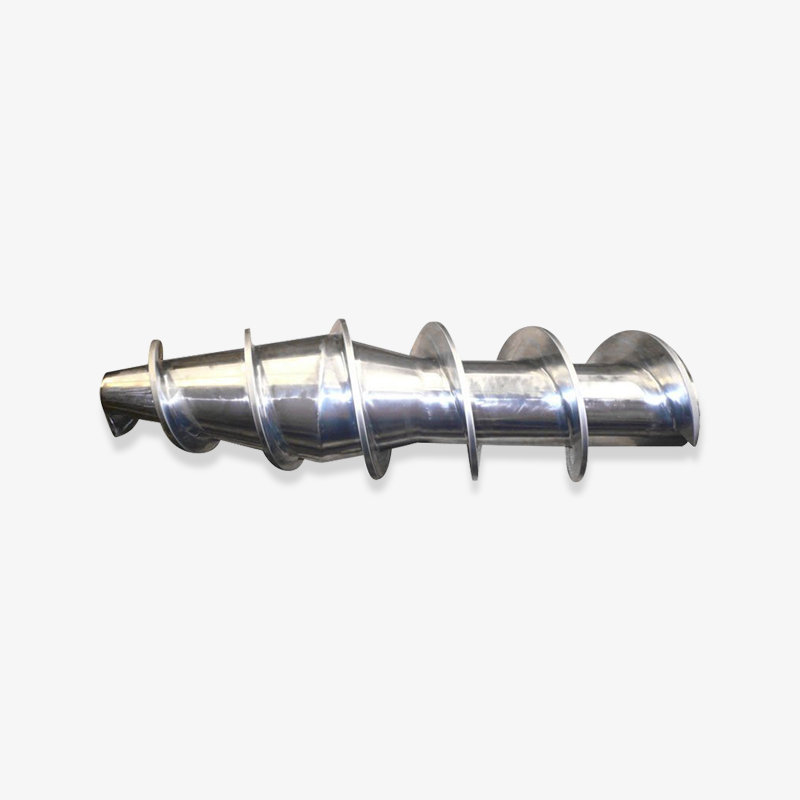
A single-screw extruder uses one screw inside one barrel. It is the workhorse for pipe, sheet, profile, wire coating, and many general-purpose extrusion lines. Its strengths are simple construction, stable pumping, and relatively low maintenance cost. It handles a wide range of commodity polymers, including polyethylene, polypropylene, polystyrene, and PVC formulations. The limitations appear with difficult mixing requirements, high filler loadings, or materials that need strong dispersive mixing. A single screw can be modified with mixing pins, barrier flights, or Maddock sections, but it still relies mainly on drag flow and pressure flow.
For a pipe or profile producer, a single-screw line with a well-matched screw and bimetallic barrel is often the most economical choice. The key is to match the compression ratio and channel depth to the material bulk density and melting behaviour. A screw designed for high-bulk-density pellets may not feed regrind or powder efficiently. That is a purchasing detail worth confirming with the screw and barrel manufacturer before the line is built.
Twin-Screw Extruders: Parallel and Conical
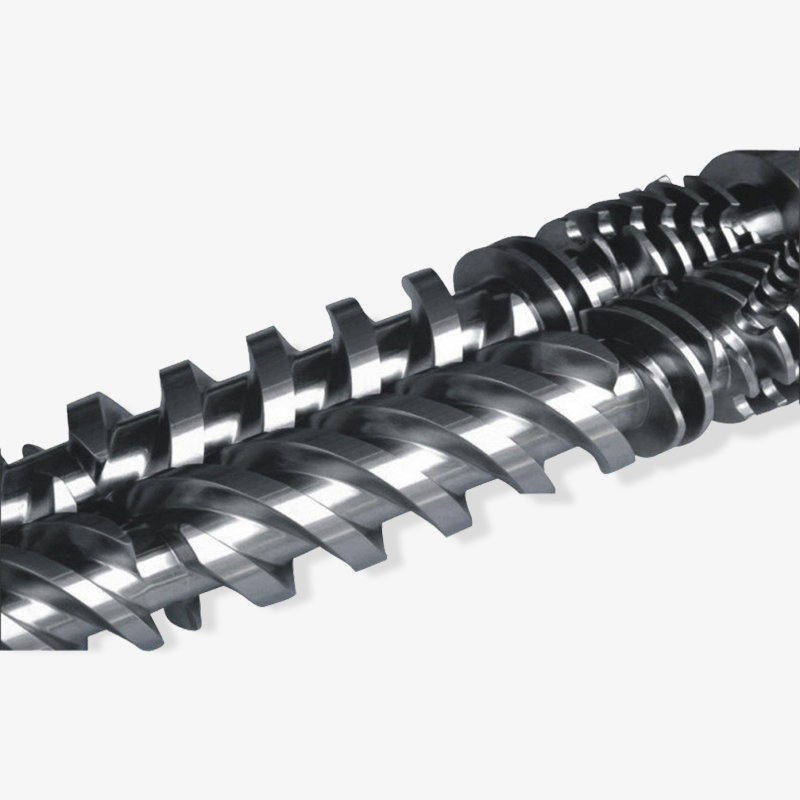
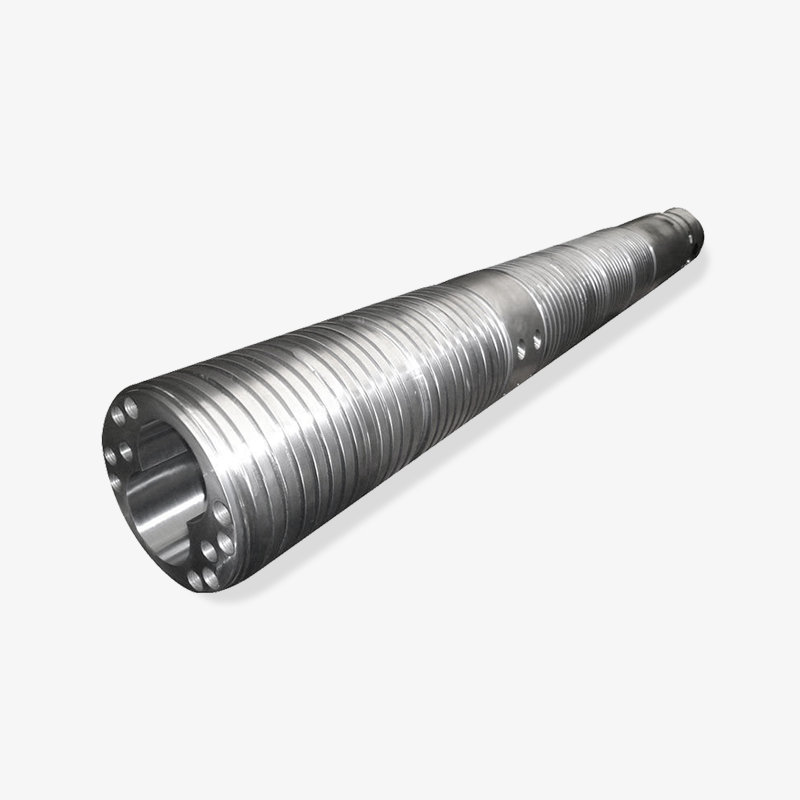
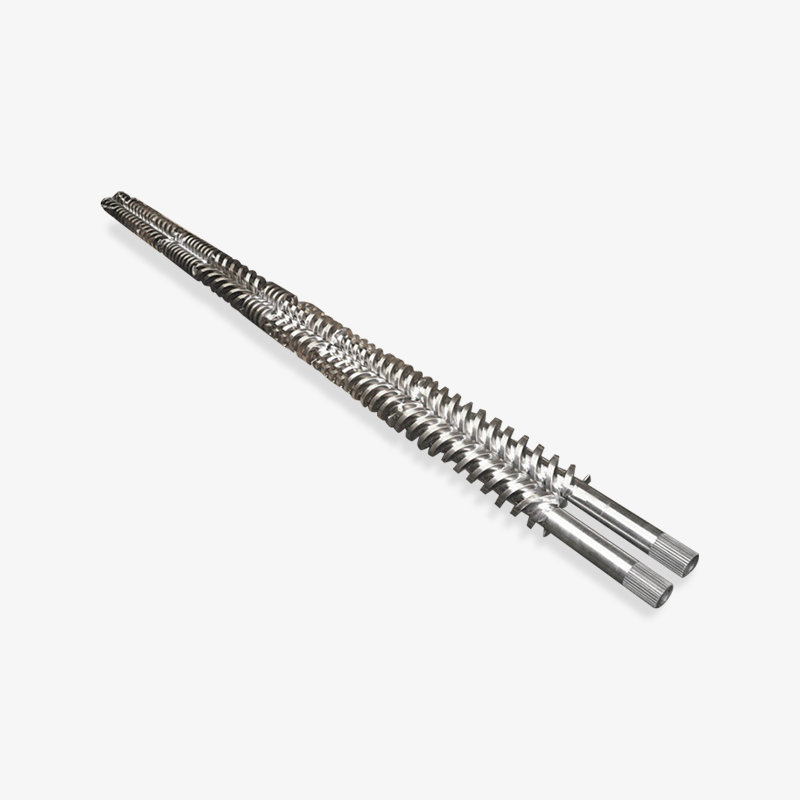
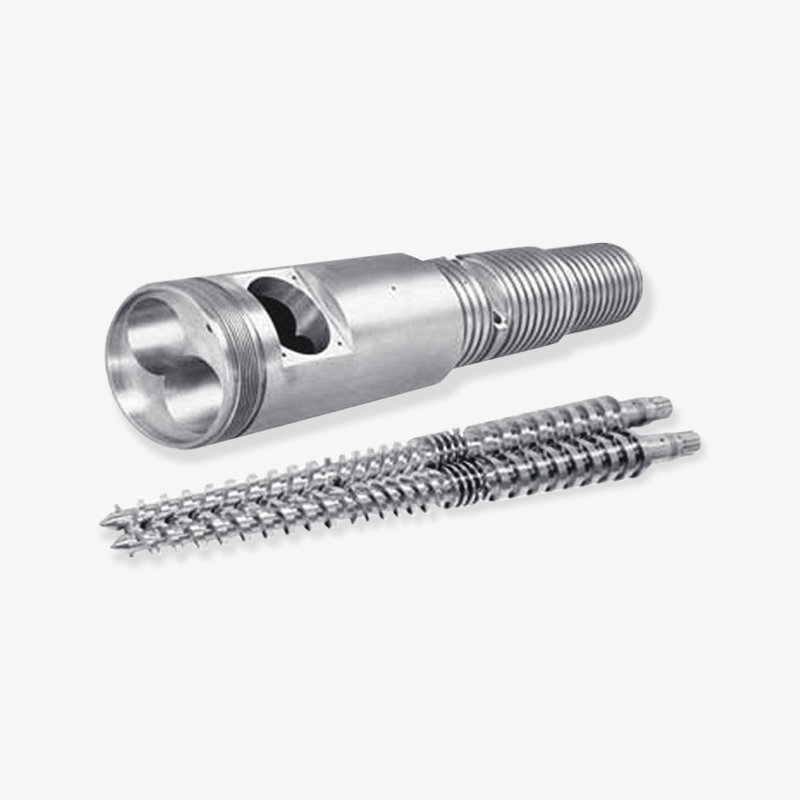
Twin-screw extruders use two screws inside a figure-eight barrel. They divide into parallel twin-screw and conical twin-screw designs. Parallel twin-screw machines are common in compounding, masterbatch, and high-output pipe or profile lines. Conical twin-screw machines are widely used for PVC pipe, profile, and sheet because the conical geometry provides a large feed volume at the rear and a smaller metering volume at the front. That helps with PVC powder feeding and gentle processing. Both designs offer better positive conveying and mixing than a single screw, especially when the screws are intermeshing and co-rotating or counter-rotating.
The trade-off is complexity. Twin-screw extruders have more wear surfaces, tighter tolerances, and higher spare-part costs. The screw and barrel elements are usually modular, which allows a processor to change conveying, kneading, and mixing elements along the shaft. That flexibility is valuable for compounders and masterbatch producers, but it also means the screw configuration must be documented and controlled. A twin-screw line that runs well on one formulation may need a different element sequence for another. For a plastics machinery factory, offering a documented screw configuration and a replacement element plan is part of the value proposition.
Planetary Screw Extruders
A planetary screw extruder uses a central screw surrounded by several planetary screws inside a grooved barrel. The design creates a large surface area for heat transfer and gentle, uniform mixing. It is often chosen for PVC, rigid and plasticised, as well as for materials that are sensitive to high shear or local overheating. The planetary screw and barrel set is more specialised than a standard single screw, so replacement parts should come from a supplier with experience in that geometry. The advantage is a very homogeneous melt with low shear stress, which helps with thermal stability and surface quality.
| Type | Best suited to | Mixing and conveying behaviour | Buying considerations |
|---|---|---|---|
| Single screw | Pipe, sheet, profile, wire coating, general purpose | Drag flow, stable pumping, moderate mixing | Lower cost, simple maintenance, geometry must match material |
| Parallel twin screw | Compounding, masterbatch, high-output pipe and profile | Positive conveying, strong mixing, modular elements | Higher spare-part cost, needs documented screw configuration |
| Conical twin screw | PVC pipe, profile, sheet, powder feeding | Large feed volume, gentle compression, good for PVC | Screw and barrel wear, alignment, and temperature control matter |
| Planetary screw | Rigid and plasticised PVC, heat-sensitive compounds | Large heat-transfer area, low shear, uniform melt | Specialised replacement parts, supplier experience is critical |
The choice is not simply about output. A single-screw line may reach the same tonnage as a twin-screw line, but the melt quality, filler dispersion, and formulation flexibility will differ. For a machine builder, the extruder type must also fit the customer’s existing downstream equipment, floor space, and operator skill level. A highly flexible twin-screw line that requires careful recipe management may not be the right choice for a factory that runs one product all year.
Match the extruder family to the material and product first; only then compare motor size, output claims, and price between suppliers.
Inside the Machine: Screw, Barrel, and Component Wear
The screw and barrel are not the only parts that fail, but they are the parts that most directly determine melt quality and output. In a typical extrusion workshop, maintenance records show a clear pattern: screw flights and barrel liners demand the most attention, followed by thrust bearings, heating and cooling systems, gearboxes, and drive motors. The pattern is not identical for every line, because abrasive fillers, corrosive polymers, and high screw speeds shift the risk profile. Still, the relative order is a useful starting point for spare-part planning.
A screw that has worn flights will leak melt backwards, reduce pumping efficiency, and force the operator to increase screw speed or barrel temperature to maintain output. A barrel with a worn liner will lose its close clearance to the screw and may develop a wavy inner surface. Both changes increase energy consumption and reduce product consistency. The problem is gradual, so the line may still run, but the defect rate and scrap rate creep up. By the time the issue is obvious, the screw and barrel often need to be replaced as a pair.
Component wear is also a purchasing signal. When a machine builder chooses a standard nitrided screw and barrel for an abrasive application, the end user may face frequent replacements. When a bimetallic barrel and a hardened screw are selected, the upfront cost is higher, but the service interval can be much longer. The same logic applies to corrosion-resistant grades for PVC or fluoropolymer processing. The chart below compares the relative wear and failure risk of major extruder components in a typical plastics processing environment.
The values are illustrative and based on common shop-floor maintenance patterns rather than a single published study. A rating of 10 means the component is among the most frequent causes of unplanned downtime or quality loss; a rating of 3 means it is relatively robust when the machine is correctly specified and maintained. Use the chart as a conversation tool with your maintenance team and your screw and barrel supplier, not as a guaranteed life prediction. Actual results depend on the polymer, filler content, temperature profile, screw speed, and cleaning practice.
For a more precise picture, track your own line for twelve months. Record the reason for every stoppage, the spare part consumed, and the hours lost. That data will show whether your extruder is limited by wear, by heating capacity, by drive torque, or by the screw design itself.
Relative Wear and Failure Risk by Extruder Component (Illustrative)
The chart shows that screw flights and barrel liners carry the highest relative risk, which matches what most processors see in practice. Screw flights are exposed to abrasive fillers, high pressure, and repeated heating and cooling cycles. Barrel liners face similar conditions plus the risk of corrosion from polymer decomposition products, especially with PVC and other halogen-containing materials. When either component wears, the other usually wears faster because the clearance changes and the melt flow becomes less stable.
The thrust bearing ranks third because it carries the axial force generated by the screw. If the bearing is undersized or lubrication is neglected, it can fail suddenly and damage the gearbox. Heating and cooling systems rank fourth because heater bands, thermocouples, and cooling fans are consumable items. They are inexpensive compared with a screw and barrel, but a failed heater zone can cause local overheating and product defects within minutes. Gearboxes and drive motors rank lower because they are usually robust when sized correctly and maintained with clean oil and proper ventilation.
For purchasing teams, the chart suggests a simple spare-part strategy. Keep at least one set of critical heater bands, thermocouples, and thrust-bearing components on site. For screw and barrel, do not wait for a breakdown to order a replacement. Because these parts are often made to order, lead time can be several weeks. A worn screw and barrel pair that is still running can become an emergency if it fails during a large order. Planning a replacement before the next busy season is usually cheaper than paying for expedited manufacturing and lost production.
For machine builders and wholesalers, the chart supports a tiered offering. Offer a standard screw and barrel set for general-purpose applications, a bimetallic set for abrasive or corrosive compounds, and a specialised set for PVC or foam. Document the expected service conditions for each tier so the end user can choose with clear expectations. That approach reduces finger-pointing when a standard set wears out early in a demanding application.
The relative risk also changes with screw design. A barrier screw with a long melting section may reduce unmelted particles but increase residence time and thermal stress. A mixing-pin section may improve colour dispersion but add pressure drop. Every design choice shifts wear and failure risk somewhere else. That is why the screw and barrel should be specified together with the process recipe, not as isolated catalogue items.
Finally, remember that the chart measures relative risk, not absolute life. A well-maintained line running clean, unfilled polypropylene may see very different numbers from a line running 40 percent glass-filled nylon. The purpose of the chart is to prioritise attention and budget. If your maintenance records show a different order, trust your records and adjust your spare-part plan accordingly.
Screw flights and barrel liners dominate wear risk, so they deserve the first place in your spare-part budget and your preventive maintenance schedule.
How to Choose an Extruder or Replacement Screw and Barrel
Choosing an extruder or a replacement screw and barrel starts with the material and the product, not with the machine size. A supplier who asks only for the screw diameter and length is not asking enough. The specification should include the polymer family, filler type and percentage, bulk density, target output, melt temperature range, maximum allowable shear, and the desired service life. Those inputs determine screw geometry, compression ratio, barrel material, and surface treatment.
A Practical Selection Checklist
- Define the polymer and any additives, fillers, or regrind content. Abrasive fillers require wear-resistant barrel liners and hardened screw flights.
- Confirm the target output in kilograms per hour at the expected screw speed, not just the maximum motor power.
- State the melt temperature window and the maximum allowable residence time. Heat-sensitive materials need a gentler screw design and tighter temperature control.
- Choose the extruder type: single screw for stable pumping, twin screw for mixing and compounding, planetary for low-shear PVC processing.
- Select the barrel material: nitrided for general use, bimetallic for abrasive or corrosive service, and specialised alloys for severe applications.
- Confirm the screw dimensions, including diameter, length-to-diameter ratio, channel depth, flight pitch, and compression ratio.
- Ask for a dimensional inspection report and a hardness test report for the screw and barrel before shipment.
- Plan the installation, alignment, and commissioning procedure, including heater band fit and thermocouple placement.
- Agree on the spare-part list and the recommended spare parts to keep on site.
- Document the screw configuration and process settings so future replacements can be replicated.
The cost of a screw and barrel set is not the whole cost. Consider the energy consumption over the service life, the scrap rate during the wear period, and the downtime cost when a replacement is needed. A lower-priced screw that wears quickly can be more expensive than a bimetallic set that lasts several times longer. For a wholesaler or distributor, offering a clear comparison between standard and premium options helps customers make a rational decision instead of buying on price alone.
Working With a Screw and Barrel Manufacturer or Supplier
When you work with a screw and barrel manufacturer or supplier, ask for evidence of process control. A qualified supplier should be able to explain how the screw is machined, how the flights are hardened, how the barrel liner is applied, and how concentricity is measured. They should also be able to provide references from similar applications, such as pipe, sheet, profile, foam, or compounding. If the application is unusual, ask for a trial or a sample inspection before committing to a full production order.
For international buyers, logistics and communication matter as much as technical capability. Confirm the export packing, the documentation, and the lead time in writing. If the screw and barrel are custom-made, clarify the tolerances and the inspection standard. A supplier that responds promptly to technical questions during the quotation stage is more likely to respond promptly when a problem appears later. That is a simple but reliable indicator of service quality.
Supplier Snapshot Module
- Core product scope: single screws, parallel twin screws, conical twin screws, planetary screws, bimetallic screws, barrels, and screw-barrel sets.
- Application coverage: pipe, sheet, profile, wire coating, compounding, masterbatch, PVC processing, and EPE foam extrusion.
- Manufacturing base: more than 10,000 square meters of workshop space and a team of more than 60 employees.
- Export experience: products delivered to the United States, Germany, Dubai, Vietnam, Thailand, and other markets.
- Customisation: single components or complete set solutions based on material, output, and machine interface requirements.
- Support focus: timely quotation, technical clarification, and responsive communication during specification review.
For a plastics machinery factory, the supplier should be treated as part of the design team, not as a catalogue vendor. Early involvement can prevent a mismatch between the screw design and the rest of the line. When the screw and barrel manufacturer understands the downstream equipment, the die, and the product specification, they can recommend a geometry that supports stable output and longer service life. That collaboration costs little at the design stage and saves a great deal during production.
Specify the screw and barrel around the polymer, output, and service life you need; then choose the supplier who can document and repeat that specification.
Maintenance and Troubleshooting Basics for Extruder Screw and Barrel
Maintenance is where the theoretical answer to what is an extruder becomes a practical daily routine. The screw and barrel cannot be inspected while the line is running, so the maintenance plan must rely on process data, scheduled shutdowns, and recorded wear measurements. A small drop in output at the same screw speed and temperature profile is an early warning. A rise in motor current or melt pressure may indicate wear, contamination, or a temperature-control problem. Operators should record these values at standard conditions so trends can be compared over time.
- Check heater bands and thermocouples every month for tight fit and correct reading.
- Record screw speed, motor current, melt pressure, and output at a standard product changeover.
- Inspect the screw and barrel during every major shutdown; measure flight diameter and barrel inner diameter.
- Clean the screw with a proper purging compound and avoid aggressive scraping that damages the surface.
- Store spare screws vertically or in a protected rack to prevent bending and surface damage.
- Replace worn thrust-bearing components before they damage the gearbox.
- Verify barrel alignment after any gearbox or flange work.
- Keep a log of every screw and barrel replacement, including hours run and material processed.
When output drops and quality becomes unstable, troubleshoot in a logical order. First, confirm the temperature profile and heater function. Second, check the feed throat for bridging or contamination. Third, review the screw speed and motor load. Fourth, inspect the screw and barrel for wear. If the screw flights are worn, the clearance increases and melt slips backwards over the flights. If the barrel liner is worn or corroded, the surface may be rough and the clearance may be uneven. In most cases, replacing the screw alone on a worn barrel is a short-term fix; the new screw will wear faster against a worn barrel.
Preventive Maintenance Schedule
A practical preventive maintenance schedule separates daily, monthly, and annual tasks. Daily tasks include checking temperatures, listening for unusual noise, and watching for surging or fluctuations. Monthly tasks include inspecting heater bands, checking thermocouple accuracy, and reviewing process logs. Annual tasks include measuring screw and barrel wear, inspecting the thrust bearing and gearbox oil, and planning replacements before the next high-season production run. For abrasive or corrosive applications, the inspection interval should be shorter.
Spare-part planning should follow the wear chart and your own records. Keep critical small parts on site, and place orders for screw and barrel well before the measured wear reaches the replacement limit. Because custom screw and barrel sets are manufactured to order, the lead time can be several weeks. A planned replacement during a scheduled shutdown is far less expensive than an unplanned failure during a large order. For a machine builder, offering a recommended spare-parts package with every extruder helps the end user avoid this trap.
Record standard process values, measure screw and barrel wear at planned shutdowns, and order replacements before wear becomes a breakdown.
FAQ About Extruders, Screws, and Barrels
What is an extruder used for?
An extruder is used to melt and pump plastic or rubber through a die to make continuous products such as pipe, sheet, film, profile, cable insulation, filament, and foam. It is also used in compounding and masterbatch production to mix additives, fillers, and colours into a polymer.
What is the difference between a single-screw and a twin-screw extruder?
A single-screw extruder uses one screw and relies mainly on drag flow and pressure flow. A twin-screw extruder uses two screws and provides positive conveying and stronger mixing, which is useful for compounding, masterbatch, and PVC processing. Twin-screw machines have more wear surfaces and higher spare-part costs.
Which parts of an extruder wear out first?
Screw flights and barrel liners usually wear first, especially when the material contains abrasive fillers or corrosive components. Thrust bearings, heater bands, and thermocouples are also common maintenance items. The wear rate depends on the polymer, filler content, screw speed, temperature profile, and cleaning practice.
How do I know when to replace the screw and barrel?
Replace the screw and barrel when output drops at the same screw speed and temperature, when motor current rises, when melt pressure becomes unstable, or when measured wear exceeds the allowable clearance. A sudden increase in scrap rate or unmelted particles is another sign. Replacing the screw alone on a worn barrel is usually not recommended.
What is a bimetallic screw and barrel?
A bimetallic screw and barrel uses a wear-resistant alloy liner or surface treatment on the barrel and hardened flights on the screw. It is chosen for abrasive or corrosive applications where a standard nitrided barrel would wear too quickly. The upfront cost is higher, but the service life can be significantly longer.
Can a screw and barrel be customised for my machine?
Yes. A qualified manufacturer can produce a screw and barrel to match the machine interface, screw diameter, length-to-diameter ratio, compression ratio, and material requirements. Customisation should be based on the polymer, filler content, target output, and melt temperature window, not only on the existing dimensions.
What information should I provide to a screw and barrel supplier?
Provide the polymer type, filler and additive content, bulk density, target output, screw speed range, melt temperature window, machine model, existing screw dimensions, and any quality or service-life requirements. Photos of the existing screw and barrel and a drawing of the barrel flange are also helpful.
How long does a screw and barrel last?
Service life varies widely with the application. A standard screw and barrel running clean, unfilled polymer under stable conditions may last for years. The same components running highly abrasive or corrosive compounds may need replacement much sooner. Monitoring wear and keeping records is the only reliable way to plan replacements.
The right screw and barrel specification, supported by wear records and a planned spare-parts strategy, protects output and quality far more effectively than reactive repairs.
Understanding what is an extruder is ultimately about understanding the relationship between material, screw geometry, barrel wear, and process control. The machine may look like a motor, a gearbox, and a heated barrel, but the productive heart is the screw and barrel pair. When that pair is correctly specified and maintained, the line runs at stable output, consistent quality, and predictable energy consumption. When it is mismatched or worn, every downstream adjustment becomes a temporary fix.
For plastics machinery factories, the practical next step is to review the screw and barrel specifications on your current platforms and compare them with the materials and products you expect to run in the coming year. For wholesalers and distributors, build a clear product ladder that separates general-purpose, bimetallic, and specialised screw and barrel solutions. For end users, start a wear log and measure the screw and barrel at the next planned shutdown. These are small actions, but they turn a vague question about extruders into a specific, manageable maintenance and purchasing plan.
If you are evaluating a new supplier, ask for the technical reasoning behind the recommended screw geometry and barrel material. A supplier who can explain why a particular compression ratio or liner grade fits your application is more likely to deliver a component that performs as promised. That technical conversation is often the difference between a machine that runs and a machine that runs profitably.
Treat the screw and barrel as a process-critical system, not a commodity spare part; that decision protects output, quality, and uptime across the entire extrusion line.
Selected Bearing Display


 浙公网安备33090202000520号