


 English
 中文简体
中文简体
Author: WeiBo
Date: Sep 09, 2026
Extruder Definition: Types, Components, Applications and Selection Guide
Content
- 1 Extruder Definition: More Than a Dictionary Meaning
- 2 Anatomy of an Extruder: What the Definition Implies in Mechanical Terms
- 3 How an Extruder Works: From Pellets to Profile
- 4 The Main Types of Extruders in the Plastics Industry
- 5 Where Extruders Are Used: Application Contexts
- 6 Key Specifications in Every Extruder Definition: L/D Ratio, Compression Ratio, and Output
- 7 How to Select the Right Extruder for Your Factory
- 8 Keeping Extrusion Running: Screw and Barrel Maintenance
- 9 Extruder Definition FAQ
- 9.1 What is the simplest extruder definition?
- 9.2 What is the extruder machine definition used in the plastics industry?
- 9.3 Is an extruder the same as an injection molding machine?
- 9.4 What is the difference between single screw and twin screw extruder definitions?
- 9.5 What does L/D ratio mean in an extruder definition?
- 9.6 Can an extruder process materials other than plastic?
- 10 Related Reading and Company Resources
Anyone who has ever compared quotations for a new plastic pipe line has probably typed "extruder definition" into a search engine at some point. The term looks simple, yet the machine it describes is anything but. An extruder is a production machine that continuously feeds raw material, melts or plasticizes it, builds pressure, and forces it through a shaped opening called a die to create a continuous product such as a pipe, film, or profile. In the plastics industry, the extruder definition always includes the screw and barrel pair, because these two components determine whether the material melts evenly, mixes well, and reaches the die at a stable pressure. As a screw and barrel manufacturer operating since 1990, our team regularly explains the extruder definition to machine builders and plant operators who need a precise answer before they spend money on equipment.
Key point: An extruder is a continuous processing machine, not a simple pump. Its real performance comes from the screw and barrel design, the material of construction, and the process control around them.
Extruder Definition: More Than a Dictionary Meaning
Any serious study of the extruder definition starts with the dictionary, because that is where most buyers expect a simple sentence. A general-purpose dictionary will say that an extruder is someone or something that extrudes, specifically a machine that shapes material by forcing it through a die. That sentence is technically accurate, but it leaves out nearly everything a procurement engineer needs to know. The plastics industry uses a narrower and far more useful plastic extruder definition: a machine that takes solid polymer granules or powder, softens them by a combination of barrel heat and mechanical friction, homogenizes the melt, and pushes it continuously through a die to form a product with a constant cross-section.
The extruder machine definition used in engineering documents goes one step further. It describes the equipment by its screw configuration, barrel length, drive power, heating and cooling zones, and the pressure that the screw is able to generate at the die. In other words, the engineering definition replaces a general description with measurable parameters. A single screw extruder with an L/D ratio of 28 and a compression ratio of 2.8 is a precise working definition of that specific machine, while the dictionary definition is the same for every machine on the market.
Historically, the extruder definition grew out of much older devices. The first extrusion machines were manually operated presses used for lead pipe and clay products. Continuous screw extrusion appeared in the middle of the nineteenth century, and the modern thermoplastic extruder took shape after the Second World War as the petrochemical industry made it possible to process polyethylene, polypropylene, and PVC in large volumes. Today the same fundamental principle runs through almost every modern application, from compounding lines that make masterbatch pellets to giant pipe extrusion lines that produce water supply pipes at several hundred kilograms per hour.
The implications of the extruder definition are practical. Because the machine works continuously, any interruption in feed, any fluctuation in barrel temperature, or any change in screw speed is visible almost immediately in the product quality. That is why a definition that ignores the screw and barrel is incomplete. The screw is the component that conveys and melts the material. The barrel is the component that contains the melt and transmits heat. Together they account for the melting capacity, the mixing efficiency, and the pressure stability of the entire line.
Key point: A complete extruder definition must combine the material being processed, the screw and barrel geometry, and the measurable process parameters such as L/D ratio, compression ratio, rotation speed, and die pressure.
Anatomy of an Extruder: What the Definition Implies in Mechanical Terms
When an experienced engineer reads the extruder definition, the mind immediately jumps to the machine's physical components. The screw and barrel are the working pair that performs the actual extrusion work, but they depend on several support systems to function properly. Understanding these components helps buyers judge whether a quotation is realistic or dangerously underspecified.
The Screw and Barrel as the Heart of the Machine
The screw rotates inside a precisely machined barrel with a small, controlled clearance between the screw flight tip and the barrel wall. In a single screw extruder, the screw has three geometric regions, known as the feed zone, the compression zone, and the metering zone. The barrel is normally heated by electric heaters arranged in separate zones along its length, and each zone has a thermocouple that feeds temperature data back to the controller. The screw is made from hardened alloy steel, often with an additional nitrided, tool steel, or bimetallic surface treatment, because the combination of high pressure, abrasive fillers, and corrosive decomposition gases creates serious wear conditions.
Supporting Systems that Make the Extruder Definition Complete
Outside the screw and barrel, an extruder also has a drive motor and gearbox, a hopper or feed system, a screen changer and breaker plate, a die, and a cooling and haul-off system. The drive determines the maximum torque and speed range. The hopper controls how consistently material enters the machine. The screen changer filters out contaminants and unmelted particles before the melt enters the die. The die shapes the melt, and the downstream equipment pulls the extrudate away at a speed that is synchronized with the extrusion rate.
| Component | Function | Consequence of failure |
|---|---|---|
| Screw | Conveys, compresses, melts, and homogenizes the material | Low output, poor mixing, melt temperature surges |
| Barrel | Contains the melt and transfers heat to the material | Scoring, thin walls, temperature control failure |
| Drive motor and gearbox | Provides torque and rotation speed | Torque limit alarms, pulsating output, unscheduled downtime |
| Hopper and feed throat | Feeds granules or powder at a stable rate | Bridging, flow interruption, inconsistent output |
| Heating and cooling system | Controls barrel temperature zone by zone | Degradation, shark skin, dimensional variation |
| Screen changer and breaker plate | Filters the melt and builds back pressure | Gels in the product, pressure fluctuation |
| Die | Shapes the melt into the final cross-section | Weld lines, die lines, poor dimensional accuracy |
The extruder definition, therefore, is not complete until it includes both the precision components and the peripheral equipment. Most machine builders purchase the screw and barrel separately from a specialized manufacturer, because the screw design is custom made for a particular polymer and product family. The barrel and screw must be inspected and matched as a pair, and their respective materials of construction must be selected for the process conditions.
Key point: The screw and barrel are the two components that turn a motor and a pile of heaters into a real extruder. Their material, geometry, and fit define the machine's output quality and service life.
How an Extruder Works: From Pellets to Profile
The extruder definition is best understood by following a single pellet through the machine. This practical view shows why each part exists and what will happen when something goes wrong.
The Extrusion Process Step by Step
- Granules or powder are loaded into the hopper and fall into the feed throat.
- The rotating screw catches the material and moves it forward along the flights.
- The material becomes compacted as the screw channel depth decreases and friction takes over.
- Barrel heaters and mechanical shear heat the material above its melting or glass transition temperature.
- The screw kneads the molten mass and blends in additives, colorants, or fillers.
- Pressure builds at the screw tip as the melt meets the breaker plate and screen pack.
- The melt is forced through the die and takes the shape of the final product.
- Calibration sleeves, water baths, or cooling rolls solidify the extrudate.
- A haul-off unit pulls the finished product at a controlled speed, and a cutter or winder collects it.
Extrusion Zones inside the Screw
A single screw extruder is classically divided into three functional zones. In the feed zone the screw flights have maximum depth, so the material is simply conveyed and slightly warmed. In the compression zone the flight depth becomes shallower, forcing the material into a smaller volume and increasing the friction that generates heat. In the metering zone the depth is constant and shallow, and this zone controls the pumping uniformity and the final melt temperature. The three zones are not fixed in length for every application. A material that melts slowly, such as a high molecular weight polyethylene, needs a longer compression zone. A shear-sensitive material such as rigid PVC needs more gentle conditions to avoid over-heating and decomposition.
Temperature and Pressure Control
Barrel temperatures are set in separate zones, usually from three to eight zones along a single screw barrel. The temperature profile is not flat; in most processes the feed zone is set below the melting point, and the temperature rises toward the die. The real heat input often comes less from the heaters and more from the mechanical energy of the screw. This is why the extruder definition in any engineering manual mentions specific energy input and screw speed. Pressure transducers near the screw tip and at the die entrance tell the operator whether the flow is stable. If the pressure oscillates, the cause is usually a partially blocked screen, an uneven feed, or a screw design that is not matching the material behavior.
Key point: The extrusion process is a continuous sequence, and each step depends on the previous one. Stable feeding, correct temperature profiling, and consistent screw geometry are the three conditions that keep the line running at the target output.
The Main Types of Extruders in the Plastics Industry
The extruder definition changes when you look at different machine configurations. All extruders share the same basic task of continuous shaping by pressure, but the screw design and process philosophy divide the market into distinct families.
Single Screw Extruders
Single screw extruders are the most common type in the world. One screw rotates in a heated barrel, and the material is conveyed, melted, and pressurized by the action of the rotating flights. These machines dominate classic extrusion lines for pipe, profile, sheet, film, and wire insulation. They are relatively simple to operate, have a well established design database, and are the least expensive type per kilogram of output. A typical single screw for a general purpose line has an L/D ratio between 25 and 32 and a compression ratio between 2 and 3.5. For most processing tasks, the critical part is the screw itself, because the feed depth, compression length, and mixing sections must be matched to the resin and the additives.
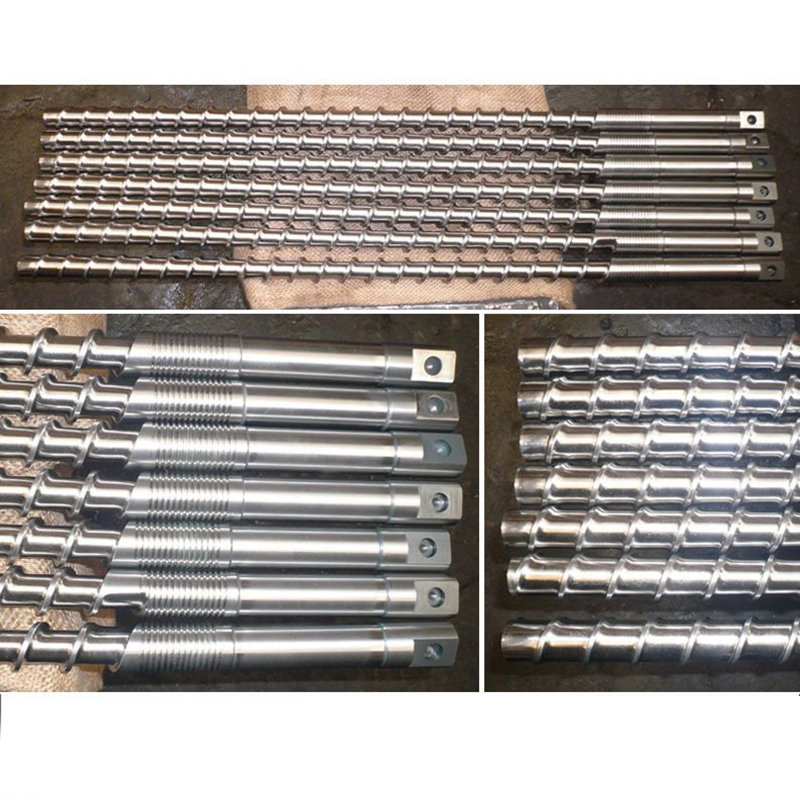 Extruder Single Screw for Plastic ProcessingThis single screw is highlighted after a comparison of screw types, and its page emphasizes dual-stage design, barrier mixing, and energy-efficient extrusion. It suits PP, PE, ABS, PS, and PC processing, offering stable output and easy mold changes for various shapes.View Product →
Twin Screw Extruders
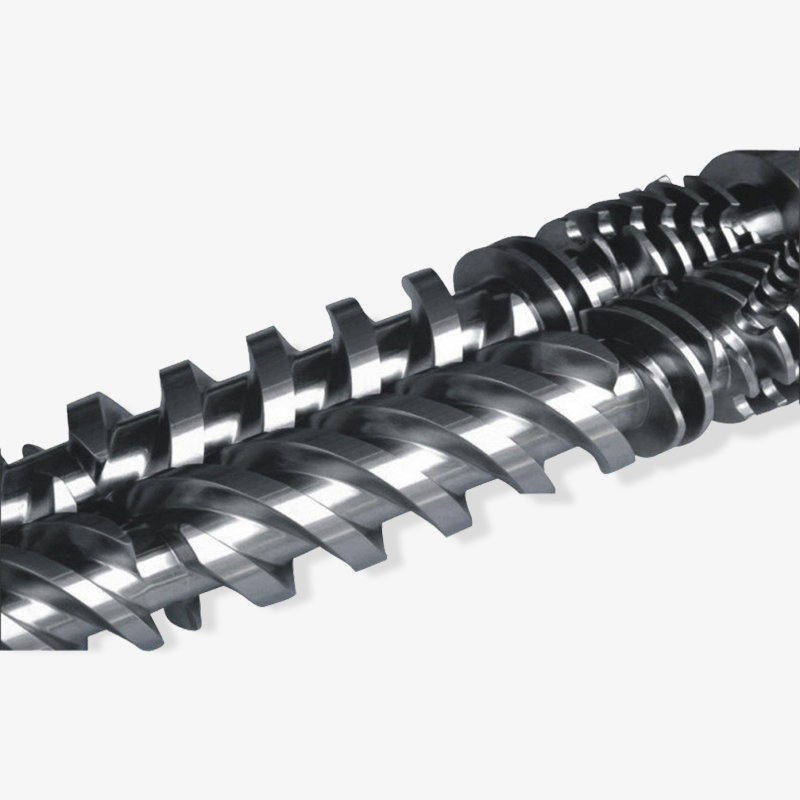
Twin screw extruders use two screws that may rotate in the same direction or in opposite directions. Co-rotating, intermeshing parallel twin screws are the standard choice for compounding, masterbatch production, devolatilization, and reactive extrusion. These screws knead the melt between the two shafts, which produces a far better mixing action than a single screw can achieve. Counter-rotating conical twin screws have a characteristic pinching action that conveys material very positively, which makes them ideal for rigid PVC powder processing in pipe and profile lines.
The extruder definition for a compounding plant is therefore not the same as the extruder definition for a PVC window profile line. Twin screw machines cost more than single screw machines, and their barrels and screws are more complex to manufacture because of the tight intermeshing clearances. The parallel twin screw has become the undisputed workhorse of the compounding industry, and the screw and barrel geometry must be designed together with the kneading block configuration to produce the correct shear history for the polymer.
Planetary Screw Extruders
Planetary screw extruders occupy a smaller but important niche. In this design, a central main screw drives a number of smaller planetary spindles that rotate in a threaded barrel ring. The material passes between the flanks of the spindles, receiving a gentle rolling and kneading action with a very large surface contact area. This construction provides excellent temperature homogenization without high shear, which makes the planetary extruder a good choice for PVC dry blends that must not be overheated, for powder coating formulations, and for calander feeding applications. The planetary barrel is usually shorter than a comparable single screw barrel, and the replaceable wear elements can be reconditioned.
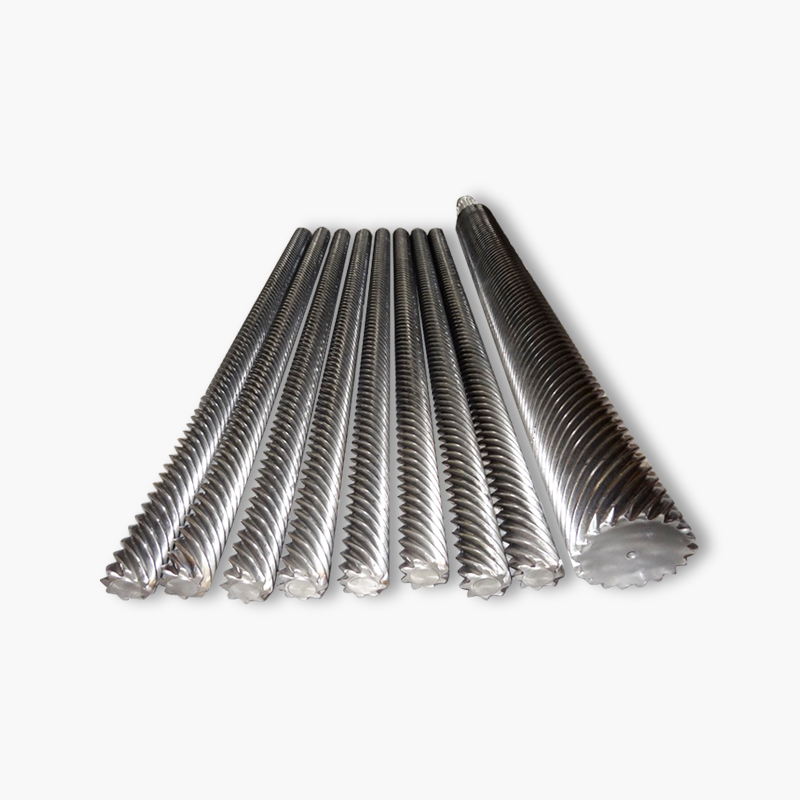 Extruder Planetary Screw with High Transmission EfficiencyPlaced after a discussion of planetary extruders for gentle kneading of heat-sensitive materials, this screw supports over 98% transmission efficiency and modular specifications. It is relevant for PVC sheets, pipes, granulation, and PET sheet applications where uniform temperature control is critical.View Product →
Other Extruder Types
Beyond screw-based machines, the extruder definition also covers ram extruders, gear extruders, and roller extruders. Ram extruders push material forward with a piston and are used for special materials such as PTFE or ceramic pastes, where continuous screw flow is difficult. Gear extruders use intermeshing gears to pump the melt, and see use as metering or melt-fed pumps. Roller extruders are less common but can be effective for very thick rubber compounds. In the broader world, food extruders process snacks and cereals, and small thermoplastic extruders are built into desktop 3D printers to melt plastic filament. All of these share the same basic definition: a machine that forces material through a restrictive opening to shape it continuously.
| Extruder type | Typical L/D | Main applications | Advantages | Limitations |
|---|---|---|---|---|
| Single screw | 25 to 32 | Pipe, profile, film, sheet | Simple, low cost, easy maintenance | Average mixing quality |
| Parallel twin screw | 30 to 38 | Compounding, masterbatch, devolatilization | Excellent mixing and venting | Higher cost and complexity |
| Conical twin screw | 20 to 26 | Rigid PVC pipe, profile, granule | Positive feeding, low shear | Limited output range |
| Planetary screw | 22 to 26 | Shear-sensitive materials, powder coating | Large surface area, gentle kneading | Narrower process window |
| Ram extruder | Not applicable | PTFE, ceramics, pastes | Handles very hard materials | Batch or semi-continuous operation |
Key point: The extruder definition only makes sense when the screw type is named. Single screw, parallel twin screw, conical twin screw, and planetary machines serve completely different processes, even though the underlying principle is identical.
Where Extruders Are Used: Application Contexts
The practical extruder definition is incomplete without application examples, because the machine is always sold to solve a production problem. The same screw and barrel manufacturer may supply parts for a PVC window line in the morning and for a compounding line in the afternoon. Each application changes the material behavior, the screw profile, and the barrel specification.
- Pipes and profiles: Pressure pipes for water and gas, drainage pipes, window profiles, cable conduits. The material is commonly PVC, PE, or PP, and the screw design focuses on stable melting and uniform pressure.
- Film and sheet: Blown films for packaging, cast films, thermoforming sheet, geomembranes. Output rates are high and the thickness tolerance is strict.
- Wire and cable insulation: Thin coatings of XLPE or PVC around metal conductors. The screw must provide excellent melt homogenization without introducing gels.
- Compounding and pelletizing: Glass fiber reinforced plastics, carbon black masterbatch, biodegradable compounds. Parallel twin screw machines dominate this field.
- Recycling lines: Wash and reclaim systems for post-consumer plastics. The extruder must filter contaminants and degas moisture and residual solvents.
- Foam and EPE extrusion: Expanded polyethylene foam sheet and rolls. A dedicated EPE screw barrel is designed for high gas injection and gentle mixing.
- Rubber processing: Tire retreading compounds, rubber profiles, hoses. Rubber extruders run at low L/D with high torque.
- Food and feed extrusion: Expanded snacks, textured vegetable protein, pet food. These machines use the same principle without the same barrel material requirements.
Application examples make the extruder definition tangible for a purchaser. When a supplier says that a machine is "a 75 mm single screw extruder," the buyer should immediately ask about the screw geometry, the L/D, the feed depth, the mixing sections, and the barrel material. The fact that a 75 mm single screw works well on a PE pipe line does not guarantee that it will work on a rigid PVC profile line. The screw and barrel are not generic spare parts; they are process engineering components.
Pipe line
Single screw, L/D 28 to 32, nitrided or bimetallic barrel.
Single screw, L/D 28 to 32, nitrided or bimetallic barrel.
Profile line
Conical twin screw for rigid PVC powder and granules.
Conical twin screw for rigid PVC powder and granules.
Compounding line
Parallel twin screw, high torque, segmented barrels.
Parallel twin screw, high torque, segmented barrels.
Foam line
SWP or dedicated EPE screw with gas injection loop.
SWP or dedicated EPE screw with gas injection loop.
Recycling line
Single screw with deep feed and high filtration area.
Single screw with deep feed and high filtration area.
Key point: The extruder definition must be connected to the final product. Every application changes the screw, barrel, and auxiliary equipment, which is why buying from a supplier who understands the actual process is essential.
Key Specifications in Every Extruder Definition: L/D Ratio, Compression Ratio, and Output
Before comparing extruder concepts, a buyer needs one number above all others: the L/D ratio. The L/D ratio is the effective threaded length of the screw divided by its external diameter. Longer ratios give the material more residence time, which improves melting and homogenizing, but they also raise torque requirements and barrel cost. Shorter ratios suit heat-sensitive materials that cannot tolerate long exposure to high temperatures. The chart below compares typical L/D values used in common extruder categories.
Rubber single screw
12:1
Conical twin screw
22:1
Planetary screw
24:1
General single screw
28:1
Parallel twin screw
34:1
High-speed film screw
36:1
Figure 1: Typical L/D ratios by extruder type and application
The horizontal bar chart shows how much screw designs vary across the extrusion industry. Rubber extruders sit at the low end because cold-feed rubber machines need only to shear and pump a softened band, not melt a crystalline polymer. Conical twin screw machines typically work in the 20 to 26 range, and the example value of 22 reflects the balanced melting length used for rigid PVC pipe and profile. Planetary extruders often operate near 24, which is long enough to plasticize powder blends without degrading shear-sensitive formulations. A general purpose single screw runs between 25 and 32, and the 28 value represents the most common specification in pipe and profile lines. Parallel twin screw compounding extruders, by contrast, commonly use 30 to 38, so the 34 bar confirms why they are preferred for reactive and devolatilizing processes. High speed single screw film lines reach 36 or even 40 because blown film requires long melting sections and stable pressure at high rotation. The obvious conclusion is that an extruder definition cannot be complete without the L/D, because the same screw diameter can deliver completely different performance at different lengths. For buyers, an L/D below 20 usually means the machine was designed for very specific, low shear work. An L/D above 35, on the other hand, increases the cost of the barrel, the screw, and the heating system. As a result, choosing a ratio means balancing material behavior, required output, and energy consumption. This is exactly the kind of question that a screw and barrel manufacturer answers every week, because the screw geometry and barrel lining are designed around the selected L/D.
Compression ratio is the second specification in the extruder definition. It is the ratio between the channel depth in the feed zone and the channel depth in the metering zone. A compression ratio of 2.5 to 3.5 is normal for polyethylene and polypropylene, while PVC requires a gentler compression. The compression ratio directly influences how much mechanical heat is generated and how well air is expelled from the granules. Screw diameter combined with flight design determines the output rate, usually expressed in kilograms per hour. When comparing two quotes, buyers should look not just at the nominal output number but at the screw speed range, the drive torque, and the melting capacity, because a screw design that is too short or too shallow will never reach the promised output.
Key point: The three numbers that define an extruder in practice are screw diameter, L/D ratio, and compression ratio. Together they determine output, melt quality, and energy consumption.
How to Select the Right Extruder for Your Factory
Selecting an extruder is a process engineering decision, not just a machinery purchase. The correct starting point is the finished product specification, because that defines the material, the output rate, and the tolerance limits. From there, the buyer can choose the screw type, the barrel length, and the material of construction. The extruder definition that a machinery supplier provides should be challenged with some straightforward questions: what is the maximum output in kilograms per hour, what resin or blend will it run, and what is the expected service life of the screw and barrel.
Selection by Material
Thermoplastics fall into two broad families from the extrusion point of view. Amorphous polymers such as ABS and polycarbonate soften gradually and can be processed on fairly standard screws. Semi-crystalline polymers such as PE and PP have a sharp melting point and need a screw with a well-designed compression region. Heat-sensitive materials such as rigid PVC require either a conical twin screw or a single screw with very low shear and a special flight geometry. Engineering plastics with glass fiber reinforcement are highly abrasive, so the barrel should be bimetallic or the screw should have a hard-facing alloy on the flight tips.
Selection by End Product
The product dimensions determine the required output and therefore the screw size. A small profile line might run a 45 mm single screw at 80 kilograms per hour, while a large pipe line could need a 200 mm single screw at more than 1500 kilograms per hour. Compounding lines usually rely on 60 to 130 mm parallel twin screws. Film lines often run at very high screw speeds and need screws with special mixing and barrier sections to avoid melt fracture. The buyer should also decide early whether the line will process a single material or a range of materials, because a machine that is optimized for one resin may be inefficient on another.
|
Scenario 1: Rigid PVC window profile Run a conical twin screw extruder with the matching cone screw and shaped barrel. The short, gentle melting region protects the PVC stabilizer system. Plan for a nitrided barrel and screws, with chrome plating as an option for corrosive formulations. Recommended partner input: confirm the powder blend recipe and the line speed before manufacturing the conical twin screw and barrel set. |
Scenario 2: Compounding recycled glass filled polypropylene Use a parallel twin screw extruder with segmented barrel sections and wearing parts made from abrasion resistant materials. The screw profile should include kneading blocks and reverse elements to create the required shear energy. Recommended partner input: request a bimetallic barrel and a wear resistant screw alloy, and ask for a wear inspection schedule. |
Buyers in international markets often work through a screw and barrel manufacturer, a wholesaler, or a specialized supplier who can produce custom OEM parts. When a machine builder or a plastics processor sources from a direct manufacturer, the conversation should cover dimensional tolerances, surface treatment, and the available design documentation. A reliable manufacturer will ask about the specific resin, the additives, the barrel temperature profile, and the screw speed range, because this information drives the design of the screw flights. This is also the stage where buyers should compare the cost of nitriding versus bimetallic lining, since the choice affects both the purchase price and the replacement interval.
Nitrided steel
Standard for clean, unfilled polymers.
Standard for clean, unfilled polymers.
Tool steel screws
Higher hardness with abrasive compounds.
Higher hardness with abrasive compounds.
Bimetallic barrels
For glass fiber and metal contaminants.
For glass fiber and metal contaminants.
Stainless screws
For corrosive and hygienic lines.
For corrosive and hygienic lines.
Daimetallic coating
Extends life on worn screw surfaces.
Extends life on worn screw surfaces.
Key point: The right extruder selection starts with the product and the material. A responsible screw and barrel supplier will ask for process data before quoting because a generic screw design cannot handle every application.
Keeping Extrusion Running: Screw and Barrel Maintenance
An extruder definition that never mentions maintenance is an engineering fiction. In real production, the screw and barrel wear out at a rate that depends on material, temperature, and mechanical stress. The most common failure mode is abrasive wear from glass fibers, calcium carbonate, titanium dioxide, and other hard fillers. The highest wear appears at the flight tips, at the compression zone, and always at the pressure build-up region near the screw tip. Corrosive wear, on the other hand, comes from HCl released by PVC, from flame retardants, and from certain recycled materials that contain residual acids.
The first sign of trouble is often a drop in output or a rising melt temperature at the same screw speed. As the clearance between the screw flight and the barrel wall increases, the material leaks backward over the flights, which reduces conveying efficiency and increases shear heat. Regular measurements of barrel inner diameter and screw flight diameter are the only reliable way to monitor this wear. Many processors wait until the product quality falls outside the tolerance, by which time both the barrel and screw may need repair or replacement.
Begin with these maintenance practices:
- Measure screw flight diameter and barrel inner diameter at every planned shutdown, and record the values in a wear log.
- Check the screw straightness, since a bent screw creates one-sided clearance and local over-heating.
- Remove the screw carefully, following the correct extraction procedure, and clean it with the right polymer purge, not by wire brushing the surface.
- Inspect the barrel heating zones and thermocouples, because uneven temperature accelerates local wear.
- Keep the machine aligned and the thrust bearing in good condition, because axial play damages the screw root and the barrel flange.
- Store spare screws vertically or on support blocks, and protect the surface with anti-corrosion oil.
When wear reaches the design limit, the processor has two options. The first is to dimensionally restore the barrel by honing, and to replace or re-coat the screw. The second is to purchase a new screw and barrel pair, often a practical choice if the original screw was designed for an old process. For highly abrasive applications, upgrading to a bimetallic barrel with a tungsten carbide lining can multiply the service life two to three times. A bimetallic screw with hard-faced flight tips is also an economical upgrade because the base body retains its toughness while the wear surface resists abrasion.
Key point: Most unscheduled extrusion stops are caused by screw and barrel wear that was documented too late. A simple wear measurement routine helps processors plan replacement during a scheduled shutdown instead of cleaning up an emergency failure.
Extruder Definition FAQ
What is the simplest extruder definition?
The simplest extruder definition is: a machine that forces a material through a die under pressure to create a continuous product with a fixed cross-section. In plastic processing, this means feeding granules or powder into a heated barrel and using a rotating screw to melt and push the material forward through the die.
What is the extruder machine definition used in the plastics industry?
In the plastics industry, the extruder machine definition includes the complete processing system: the screw, barrel, drive, heating and cooling zones, screen pack, die, and downstream haul-off equipment. The machine must melt or plasticize the polymer, homogenize it, and generate enough pressure to produce a uniform product at the required output rate.
Is an extruder the same as an injection molding machine?
No. An extruder operates continuously, and the melt leaves the die as an endless profile. An injection molding machine works in cycles, using a reciprocating screw to melt the polymer and inject it into a closed mold that shapes discrete parts. Both use a screw and barrel, but the process logic and the screw movement are different.
What is the difference between single screw and twin screw extruder definitions?
A single screw extruder has one screw rotating in an unthreaded barrel and is the standard choice for pipe, profile, and film. A twin screw extruder has two intermeshing screws and provides far better mixing, venting, and controlled residence time, which makes it the standard choice for compounding and reactive processing. The extruder definition should therefore name the screw configuration before any performance comparison is made.
What does L/D ratio mean in an extruder definition?
L/D ratio is the effective length of the screw divided by its outer diameter. A 75 mm screw with an L/D of 28 has an effective length of 2100 mm. Longer ratios provide more heating, melting, and mixing time, while shorter ratios protect heat-sensitive materials and reduce the torque load on the drive.
Can an extruder process materials other than plastic?
Yes. The extruder definition covers metals such as aluminum, clay and ceramics, rubber compounds, food doughs, and even pharmaceutical pastes. These materials are processed with the same basic principle of pressure-driven flow through a die, but the screw, barrel, heating system, and downstream equipment are designed for the specific material behavior.
Key point: The FAQ answers cover the difference between continuous extrusion and cyclic molding, the importance of screw configuration, and the role of L/D ratio, which are the three questions every buyer should ask before contacting a supplier.
Related Reading and Company Resources
If the extruder definition has raised deeper questions about screw design, we have prepared a set of practical resources from our engineering team. These references explain how specific screw technologies influence mixing, conveying, and process stability, and they give a straight-forward view of the manufacturing capabilities behind the screw and barrel pairs we deliver to machine builders around the world.
- Parallel twin screw technology: mixing, conveying, and processing efficiency - a technical walkthrough of co-rotating screw geometry.
- Company overview: screw and barrel manufacturing since 1990 - production facilities, quality commitment, and global service experience.
Key point: The best extruder definition for your facility is the one that matches your material, product, and maintenance plan. Start from the facts, check the screw and barrel specifications, and ask a manufacturer with proven experience.
Selected Bearing Display


 浙公网安备33090202000520号